

Economic uncertainty stemming from the United States trade war battered Toronto real estate sales in 2025, but lower prices, stable interest rates and clarity around the fate of a major trade deal could help restore confidence in the market this year.
Economists currently expect the Bank of Canada to hold its benchmark interest rate steady at 2.25 per cent in 2026, which may prod homebuyers to start making moves instead of waiting for the next cut, said Tom Storey, a realtor with Royal LePage.
“It seems like fixed rates are probably the lowest they’re going to be for a while now, based on what the bond yield is doing,” he said. “That certainty with rates remaining where they are is going to be a big factor helping people make decisions this year.”
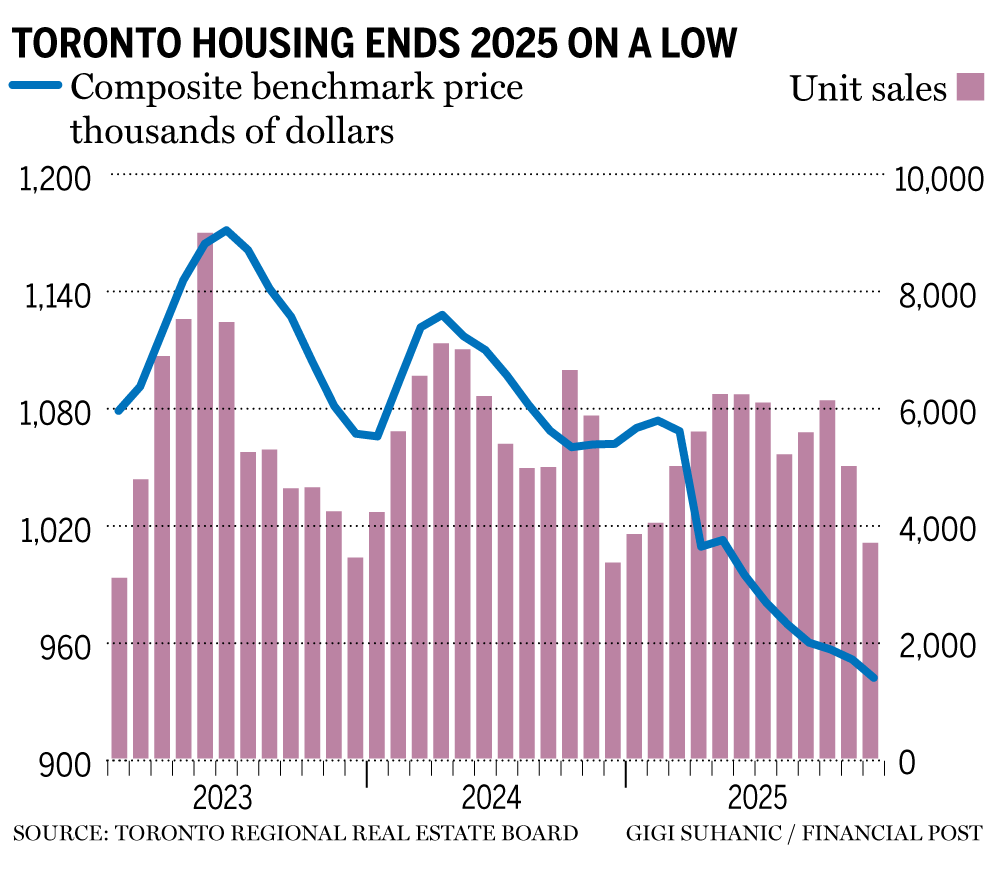
The Toronto Regional Real Estate Board’s (TRREB) latest market report, released on Wednesday, showed sales were down 11.2 per cent across the Greater Toronto Area (GTA) in 2025 compared to a year earlier. New listings jumped 10 per cent, “allowing for selling prices to be negotiated downward,” the report said.
TRREB said the annual average selling price in 2025 was $1,067,968, down 4.7 per cent compared to $1,120,241 in 2024.
“The GTA housing market became more affordable in 2025 as selling prices and mortgage rates trended lower. Improved affordability has set the market up for recovery,” TRREB president Daniel Steinfeld said in a release.
Storey said homes may be slightly less expensive compared to previous years, but that doesn’t necessarily make them affordable. He said it’s important to note that most people are purchasing properties with mortgages, and he encourages buyers to calculate how much owning will actually cost them on a monthly basis.
“In 2025 we had a meaningful change in the prices of real estate. We had a much more minor change in the true cost of owning real estate if you need a mortgage,” he said.
TRREB data shows home sales ended 2025 with an 8.9 per cent decline in December compared to the year before, while the average selling price dipped 5.1 per cent to $1,006,735. The composite benchmark price, which represents a “typical” home, dropped six per cent to $942,300.
Sales of all dwelling types declined year-over-year in December, including detached (1.7 per cent) and semi-detached homes (6.9 per cent), townhouses (22.5 per cent) and condos (11.2 per cent).
After Toronto’s condo market weathered a year of falling prices, a drop in new and existing unit sales and a glut of inventory and project cancellations, Storey said he expects softness to continue on the new construction side and doesn’t expect prices to move higher in the resale market.
“I think the major corrections have happened, and I believe certain types of properties will sell a lot better than others, but there will still be a little bit of downward pressure (on prices),” said Storey.
The upcoming review of the Canada–United States–Mexico Agreement (CUSMA) this year will be another catalyst for the real estate market in the coming year.
“Reaffirmed trade relationships and large-scale domestic economic development projects will be key for improved home sales moving forward,” TRREB chief information officer Jason Mercer said in a release. “GTA households must be confident in their employment situation before committing to long-term monthly mortgage payments, even in this more affordable market.”
Storey said even a slight uptick in overall consumer confidence could help sales volume pick up in 2026, but it won’t necessarily impact prices in the near term.
“Personally, I think sales will be a little bit better. But best-case scenario, and I say this in a nice way, a ‘boring’ real estate year in Toronto would be a wonderful thing. Stable rates, stable prices and a little bit higher sales volume.”
• Email: jswitzer@postmedia.com