

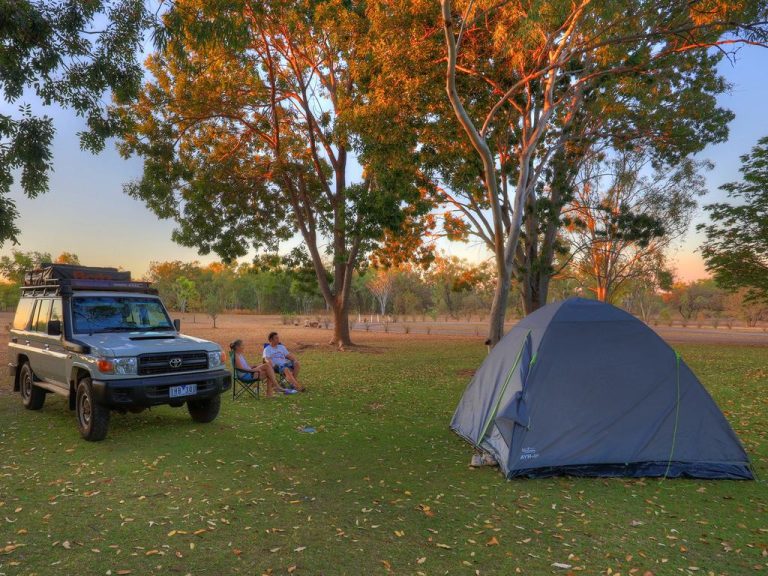
Discovery Parks at Katherine in the Northern Territory.
Australia’s largest regional accommodation provider G’day Group is clearly betting on limited petrol price hikes having recently bulked up its portfolio with the purchase of four caravan parks spread across Victoria, the Northern Territory and Western Australia.
G’day Group-owned Discovery Parks has spent more than $40m acquiring parks in the Victorian village townships of Halls Gap and the Grampians, along with a site at Katherine River in the NT and in the coastal enclave of West Busselton, south of Perth. The purchase takes Discovery Parks holdings to 101 sites.
In a statement, Discovery Parks said the acquisition of four Breeze Holiday Parks was expected to contribute more than $50m in annual economic benefit for the group which has ambitious plans to double its size by 2031.
The Discovery Parks group will also outlay up to $250m investing in regional Australia through further acquisitions and significant investment in flagship properties including in Byron Bay, and at Bargara north of Brisbane, Woodman Point in Western Australia, Canberra, and Tasmania’s Cradle Mountain.

Grant Wilckens, CEO of G’Day Group, which he founded 22 years ago.
G’day Group founder and chief executive Grant Wilckens said the group was now setting its sights to double in size by 2031 with ambitions for G’day Group to become a $4.5bn market leader.
Australian Retirement Trust’s general manager mid-risk assets, Michael Weaver, said as a long-term owner of G’day Group, the super fund is proud to support its continued expansion, helping to develop Australian regional tourism while generating strong long-term returns for its members.
“We believe long-term ownership provides businesses with the confidence to invest, grow and innovate, and G’day Group’s success is a great example of how super can support local communities and economic growth,” Mr Weaver added.
The acquisition comes as new CBRE Research reveals Australia competes as a premium long-haul destination, where distance, airfares and international connectivity have a greater influence on visitor demand.

Discovery Park at Katherine in the Northern Territory.
“While recent geopolitical disruption, higher fuel costs and aviation constraints have tempered growth, underlying demand fundamentals for Australia remain well positioned to support further expansion as conditions normalise,” according to CBRE Research.
The report noted that Australia’s international arrivals are now at 98 per cent of pre-pandemic levels, signalling tourism recovery as largely complete. It predicts the accommodation sector is set to enter a new growth phase where Australia could increase its share of global travel.
The report shows that for the 12 months to May 31, international arrivals to Australia reached 9.16 million, up 9 per cent year-on-year and equivalent to 98 per cent of 2019 levels.
However, Australia’s population has grown since 2019, meaning the same number of international visitors now represents a smaller demand base.
“While Australia will always compete as a premium long-haul destination, there remains real capacity to increase international visitation over time,” said CBRE’s head of hotel research, Ally Gibson.
“For hotel owners and operators, the opportunity is not whether demand will grow, but by how much. If Australia can modestly increase international visitation while maintaining today’s higher-value visitor profile, the upside for hotel performance is significant,” Ms Gibson added.
The report found average visitor expenditure increased by 31 per cent from $5,195 in the year ended March 31, 2019 to $6,795 in the year ended March 2026. Average hotel stays also lengthened from 6.7 nights to 8.6 nights, increasing the value of each international arrival.
CBRE’s regional director of valuations, hotels, Troy Craig said Australia’s growing international tourism demand is building on a strong and resilient domestic demand base.
“Australia’s hotel sector has delivered record performance despite the slower recovery in international visitation with domestic travellers accounting for 70 per cent of hotel room nights. This domestic driven strength provides insulation from changing global travel conditions, while further growth in international visitation represents a significant source of additional demand,” Mr Craig added.