

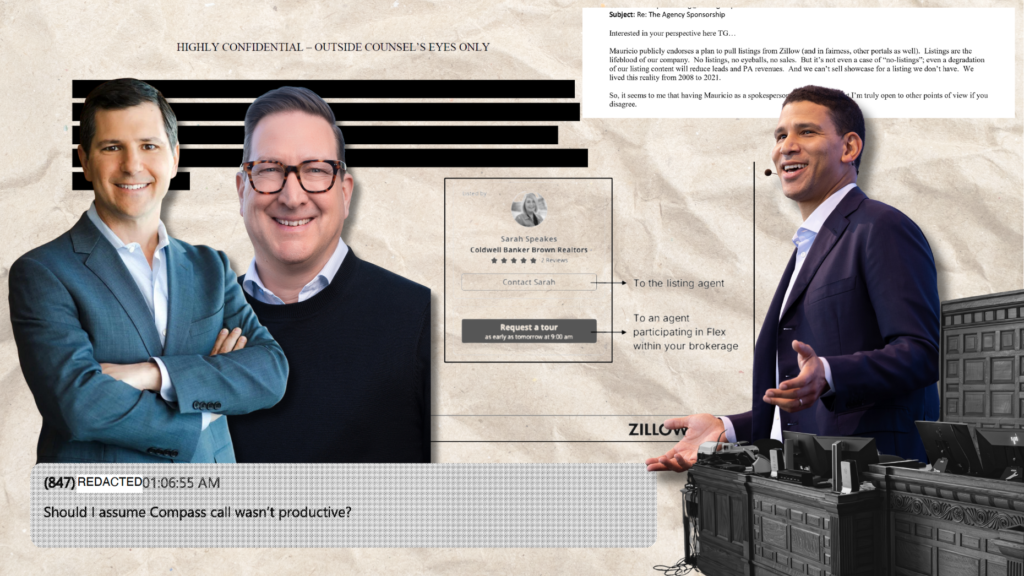
A day after Zillow updated its Listing Access Standards, Compass has decided to drop its lawsuit, saying the changes provide homesellers “with more choice.”
Compass has filed paperwork to dismiss its lawsuit against Zillow over the portal’s Listing Access Standards, according to an announcement on Wednesday.
The NYC-based brokerage said the decision to dismiss the lawsuit without prejudice, which means they can refile the suit in the future, was due to Zillow changing its Listing Access Standards (LAS) to be more lenient, leaving room for listing agents and their clients to properly market coming-soon listings on their platform and others, such as Redfin, Realtor.com and Homes.com, without worrying about their listing being banned.

Robert Reffkin
Compass founder and Compass International Holdings Chairman and CEO Robert Reffkin said the change resolved the brokerage’s issue with Zillow’s LAS, saying the current verbiage allows listing agents and homesellers “more choice.”
“Our goal has always been to give homeowners more choice to decide when, where, and how to market their homes,” he said in a written statement. “We are pleased to see that other brokerages are now recognizing the strong consumer demand for more options in how they sell their homes. Homeowners deserve more choices, not fewer choices.”
Zillow rolled out the updated LAS on Tuesday alongside the debut of Zillow Preview, a new platform that enables agents and sellers to “pre-market” listings while complying with local multiple listing service (MLS) rules. Keller Williams, RE/MAX, HomeServices of America, United Real Estate, and Side signed on as the first brokerage partners to use Preview.
The primary change is to the former requirement that listings be added to the MLS within 24 hours of being publicly marketed and published on Zillow and other sites that receive MLS feeds. The LAS now simply requires that listing agents make listings “broadly accessible to the general public in a manner that provides open access,” with no mention of a 24-hour timeline or a mandate that the listing appear on Zillow.
A Zillow spokesperson commented on Compass’ announcement, saying that the changes to its LAS aren’t an about-face, as the policy still prohibits listings that start on private listing networks.
“Zillow welcomes Compass’ decision to voluntarily withdraw its lawsuit,” they said in an emailed statement. “As we said from the outset, the claims lacked merit, and the court’s preliminary injunction ruling reinforced that view. Our standards remain in effect, and Zillow will continue to choose not to display listings that were previously hidden from the public for the benefit of any one company.”
“Any suggestion that these standards are no longer being enforced is incorrect,” they added. “Hidden listing networks that gate access to listings behind a registration wall or require buyers to work with a specific brokerage do not meet our standards.”
The spokesperson also provided a warning to the NYC-based firm, saying, “To the extent Compass continues operating a network of inventory hidden in the shadows, those listings remain at odds with our standards… The distinction is simple: Zillow Preview is public and expands access; private listing networks are closed and restrict it. We will always advocate for transparency and fairness for consumers.”
Compass’s filing effectively closes a nine-month legal battle, in which the NYC-based firm argued that Zillow’s listing ban violated antitrust laws and caused competitive harm by allegedly stifling the growth of its three-phased marketing strategy (3PM), which started listings off the MLS and moved them to coming-soon status if they went unsold. The last stage was broad distribution through the MLS, where listings would then appear on sites like Zillow.
Alongside the lawsuit, Compass had filed a preliminary injunction request asking the court to stop Zillow from enforcing its Standards until the case was settled.
The companies sparred through a series of court filings throughout the summer of 2025; however, a four-day injunction hearing in November pulled the covers off Zillow’s and Compass’s respective communications about the LAS, its purpose, how they applied to Compass’s private exclusives, and whether they negatively impacted Compass’s business strategy.
Judge Jeannette Vargas denied Compass’s injunction in February, saying the firm’s legal team had not demonstrated a likelihood of success on the merits, including claims that Zillow had formed a monopoly and colluded with Redfin to harm Compass. Vargas said that homesellers were free to continue using Compass’ 3PM strategy despite the Zillow policy, as a previous Inman article explained.
At the time of Judge Vargas’ ruling, Compass indicated it wouldn’t end the lawsuit, with Reffkin saying the denial of the injunction “wasn’t a loss.”
However, the flood of pre-marketing platforms that have debuted since February appears to have left Compass feeling victorious, with Reffkin adding on social media, “At Compass International Holdings, we will always defend our real estate professionals’ ability to put their clients first, and we will continue to advocate for more choices, not fewer, for homeowners.”
Update: This story was updated after publication with additional background and context.