

Citadines, on Elizabeth St Pier, Hobart where all rooms have water views.
Higher construction costs and tighter financial controls have combined to reduce the development of full-service hotels across several Australian markets, but serviced apartment operator Quest Apartment Hotels says it is continuing to open new properties in cities and rural areas.
The group, owned by Singapore-listed The Ascott Limited, is on track to open three new Quest properties this year: in Southport on Queensland’s Gold Coast; in the NSW rural township of Goulburn North; and on Brisbane’s Wickham Terrace.
Quest is Australasia’s largest apartment hotel group, with more than 160 properties and a target of 200 by 2030. Rivals include billionaire Harry Triguboff’s Meriton, which has 23 serviced apartments in Melbourne, Sydney, the Gold Coast and the ACT and plans a third hotel in Brisbane’s CBD with the forthcoming Meriton mixed-use development on Alice Street.
Behind Quest’s momentum is a 38-year track record that The Ascott Limited – a wholly owned subsidiary of CapitaLand Investment – is leveraging to bring a broader portfolio of challenger brands including Citadines, Oakwood and Lyf into the Australian market. Ascott has nine hotels open nationally, and will open two more this year: in Hobart and the Melbourne suburb of Epping.

One of the water-view apartments of Citadines, Hobart.
Citadines – which operates properties in Melbourne’s Bourke Street and in North Sydney – and Oakwood, with properties in Hobart, Sydney, Melbourne and Perth, are building local recognition, according to Quest.
“The commercial property angle here is not simply brand expansion,” says David Mansfield, The Ascott Limited Australasia managing director.
“Developers are looking for accommodation partners that can help reduce execution risk. “That relationship often starts well before a sod is turned.”
Quest was last week named franchisor of the year at the Franchising Council of Australia’s 2026 Industry Awards, while more than half of Quest’s current development pipeline is understood to be with developers it has worked with previously – many of which are both builders and developers.
In Hobart, a $55m-$60m gut-rebuild of the former Somerset on the Pier hotel is to reopen next month as Citadines Elizabeth Street Pier Hobart. The waterfront project is backed by an existing Quest developer.

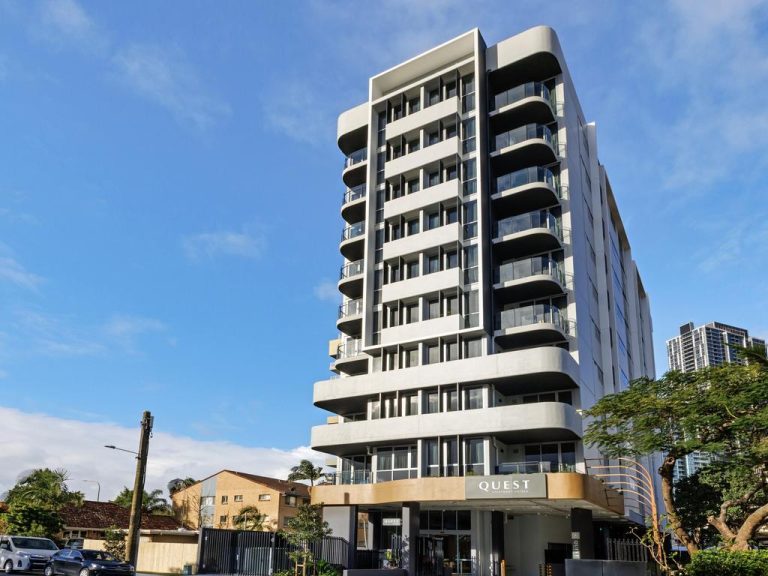
An apartment in the Southport Hotel, Queensland.
As per the previous hotel development on site, each one of the Citadines’ 98 rooms has a waterfront balcony with uninterrupted harbour views.
Competitors in Hobart’s waterfront area include The Tasman, an ultra luxury hotel that is positioned back from Hobart’s waterfront, and MAC01, which is owned by Tasmania’s Farrell family, who also owns one of Tasmania’s most luxurious properties, Saffire Freycinet at Coles Bay.
“What we’re seeing is that the demand drivers in regional and suburban markets have fundamentally changed,” Mansfield says.
“Hospitals, universities, infrastructure projects, decentralised government workforces – these are now primary demand generators in many centres, often outweighing traditional tourism (requirements).
“With land and construction costs typically lower than in capital cities, the development equation can stack up very compellingly outside the CBDs.”
On the Gold Coast, Quest Southport, which opened last month, was developed by Sam Vecchio, son of Italian migrant patriarch John Vecchio, who has built a significant property development business since his arrival from Italy.
Hoping to capitalise on demand from medical staff, the family chose the edge of the Gold Coast Health and Knowledge Precinct – home to Griffith University Medical School and one of Queensland’s largest hospital campuses. The target market is healthcare workers, medical researchers, university staff and extended-stay corporate travellers.
The same logic runs through other Ascott openings this year, including Oakwood Epping, opposite the Northern Hospital in Melbourne’s north.
There is also a housing dimension, according to Ascott.
“In markets where rental housing is difficult to secure, extended-stay accommodation has become a practical solution for companies housing contractors, project teams and relocating staff – a use case that sits outside traditional hotel underwriting assumptions but is quietly driving occupancy in regional markets and growth corridors,” it says.
“The broader shift is that accommodation is being assessed less as a tourism asset and more as enabling infrastructure. For developers trying to make projects work in a tighter market, the question is no longer simply whether a hotel brand has consumer recognition. It is whether the model – and the operator behind it – can help get a project across the line.”