

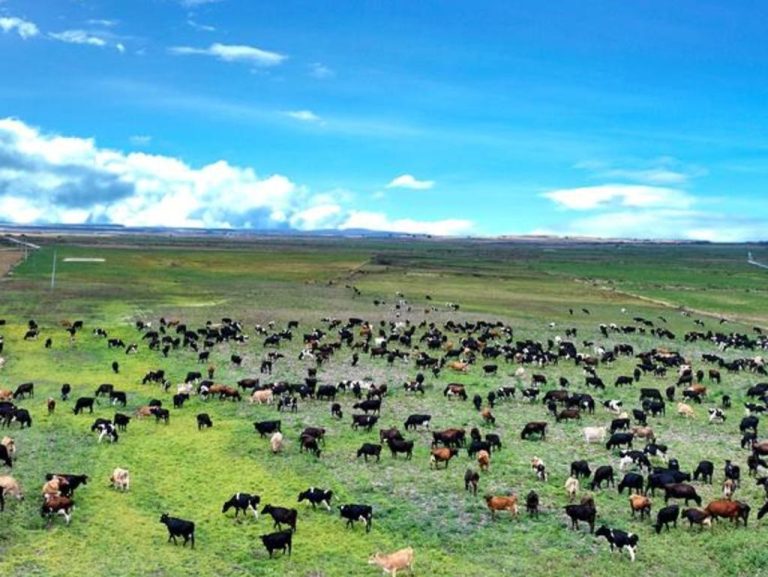
Rushy Lagoon’s sale is expected to exceed $100m. Picture: Supplied
Release of the Bendigo Bank Agribusiness’ 2026 Australian Farmland Values Report tends to be a double-edge sword for Tasmania.
On the one hand, the report found that the median price per hectare in Tasmania is higher than in any other state.
The report revealed Tasmanian farms are worth $18,424 per hectare, with Victoria being the next closest at $14,790.
However, Tassie’s median farm price for 2025 fell by about 20 per cent and the transaction volume dipped by 34 per cent.
Bendigo Bank Agribusiness relationship manager Simon Rootes said a slowdown challenged the Tasmanian farmland market last year.
MORE: Hobart’s rental shock: Now dearer than Melbourne
New data reveals Tassie mortgage stress hotspots
Heating up: Hobart home prices reach record high

Rushy Lagoon.
While properties near major centres saw increased demand, Mr Rootes said the broader agricultural sector experienced a correction, with transaction numbers falling by over one-third and prices returning to 2022 levels.
“Buyer confidence was impacted by rising input costs and dry conditions while sellers chased the high prices of previous years,” he said.
“The outlook for 2026 is clouded with uncertainty as planned shutdowns of key irrigation schemes during the critical spring planting window, coupled with the forecast of further dry conditions, cash rate uncertainty, and soaring input costs creates concern for farmers and investors alike.”
MORE: Near-complete homes now eligible for first-home buyer grants
‘Timeless’: Inside an epic two-year renovation
The report found that transaction volumes fell to the lowest on record with just 86 sales recorded across Tasmania for 2025.
It said agricultural production across the state proved challenging with dry conditions causing soil moisture to sit below average across most of the state until the start of spring, though demand for lifestyle properties remains.

Mineral Banks in Ringarooma.
The Northern region eased in both transaction volume and median price per hectare in 2025.
The number of farm sales declined to just 26, and the median price per hectare of farmland fell to $17,741, a 9.7 per cent year-on-year decrease.
The North West region’s median price of farmland fell for a second consecutive year, declining by 10.7 per cent to $24,136/ha, with 28 sales recorded.
The South region lifted marginally for 2025, with the median price per hectare increasing 8.7 per cent year-on-year to $8979/ha.
The region represents 66.1 per cent of the total area traded within Tasmania for 2025.
Nationwide, the Australian farmland market climbed 2.8 per cent to a new national record median price of $10,516 per hectare, with 6.3 million hectares of land traded.
Bendigo Bank Agribusiness senior manager industry insights, Eliza Redfern, said a subdued start to 2025 gave way to a more confident market in the second half driven by improved seasonal conditions, three RBA cash rate cuts, and strong livestock prices.
“However, widespread, uniform growth has fallen, and buyers are now more discerning, prioritising asset quality, water security, and long-term returns,” Ms Redfern said.
“A dry seasonal outlook and higher operational costs are putting pressure on margins.
“With the added prospect of rising interest rates impacting the cost of borrowing, we expect to see continued buyer caution.”
MORE: Major Moonah ‘Gateway’ site for sale
This Tassie suburb just saw demand surge 265%

Logan at Evandale.
Separate research from Rabobank reinforces the slowdown, with the agribusiness lender forecasting only modest growth ahead.
Its latest Australian Farmland Price Outlook expects national land values to rise by about two per cent in 2026, followed by subdued growth of just 0.4 per cent in 2025 — a sharp drop from the average annual gains of roughly 11 per cent over the past decade.
RaboResearch commodity analyst Paul Joules said the market had entered a new phase.
“Our base case forecast expects Australian agricultural land values to continue rising in 2026, with the median price per hectare projected to increase by around two per cent year-on-year,” he said.
“The expectation is for similarly moderate growth in land values from 2026 to 2031 with the market having firmly entered a weaker growth cycle.”