

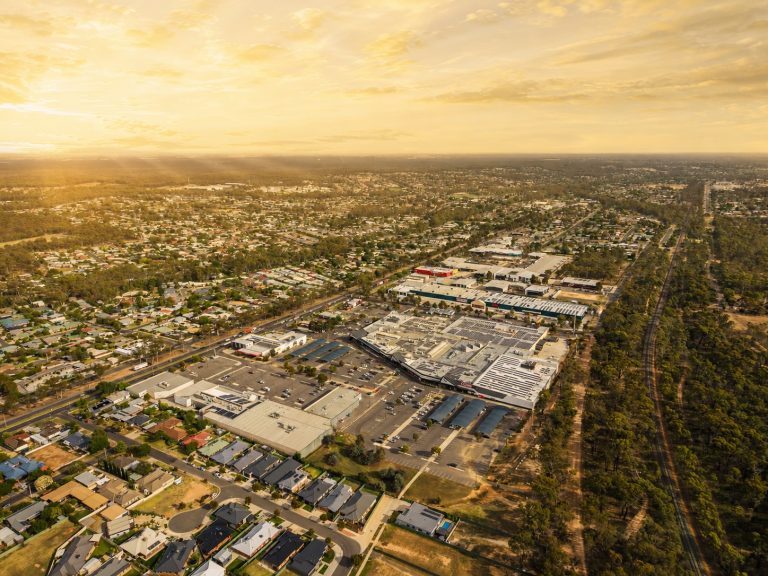
For the first time in years, retail is the most actively traded asset class, with record population growth and a shortage of new supply driving competition. And for private offshore investors, there’s a surprise destination.
Two deals in three months worth around $150m have thrown the spotlight on a quiet but powerful trend: private capital from primarily east-Asian investors is reshaping Australia’s retail property sector.
And it has a very specific target: supermarket-anchored centres in regional Victoria.
In March, Lansell Square in Bendigo — with a Coles, Woolworths and Kmart — sold for $110.1m to a private Asian investor. Two months later, a Chinese buyer paid $38.88m for a Coles and Aldi-anchored centre in Kilmore — their first Australian shopping centre purchase.
Lansell Square in Bendigo sold to a private Asian investor in March. Picture: Supplied
Stonebridge brokered both, having transacted more than $300m in shopping centres involving Asian capital in a single quarter, following the $210m sale of Burwood One in Melbourne’s east to another Asian buyer.
The numbers tell the story. Regional assets typically trade at yields of 6-7% to compensate for smaller catchments and lower liquidity. Kilmore changed hands at 5.06%, effectively pricing a country Victorian centre on par with a Melbourne one.
“It’s an eye-wateringly good deal,” admitted Sam Guest at CBRE Melbourne. “It’s a really good indication that [foreign buyers] want to do the deals. We’ve just got to give them the opportunity.”
None of this is accidental, says Stonebridge partner Kevin Tong. The Kilmore buyer had a six-year relationship with Stonebridge before signing, he said; the Bendigo buyer spent 18 months learning the sector before committing.
“This demonstrates the continued depth of private Asian capital targeting Australian retail assets,” he said.

Stonebridge Capital’s Kevin Tong. Picture: Supplied
Why retail, why now?
Supermarket-anchored centres offer defensive, non-discretionary income that held up through the GFC and Covid while discretionary retail contracted.
Nearly 60% of centres carry sub-5% vacancy, according to CBRE; occupancy costs remain below pre-2020 levels, and with only 0.7 million square metres of new supply forecast until 2028 against a national population growth forecast of one million during that time, centres are enjoying a powerful tailwind.
“There’s a lot of capital coming in from Asia seeking defensive assets, which everybody has put a higher price on given geopolitical uncertainty,” CBRE’s Sam Guest said.
“Australia is seen as a safe-haven location for this buyer profile to deploy capital,” added Mr Tong.

CBRE’s Sam Guest. Picture: Supplied
Last year was a bumper year for retail; investment hit $12.7b in 2025, according to CBRE, with total returns reaching 9.9% nationally, and sub-regional centres leading at 12.4%, says Ray White.
About 55% of Cushman and Wakefield’s $1.3 billion transaction volume – across all asset classes – for Victoria in 2025 came from offshore Asian capital.
Meanwhile Stonebridge found transaction volumes in the convenience retail sector surged 62% year-on-year.
Knight Frank said that even as overall deal flow eased in early 2026, retail held firm. In fact, it remained the most traded asset class in Q1 at $3.6b — well ahead of office ($2.1b) and industrial ($1.2b).
“Retail clearly emerged as the standout commercial property performer in 2025,” said Knight Frank’s Alistair Read.

Knight Frank’s Alistair Read. Picture: Supplied
Why Victoria, why regional?
Victoria was the most active state for sub-regional centre transactions in 2025, with $836m in deals — more than half of national volume, Stonebridge found.
The more surprising story is what’s happening beyond Melbourne. Asian investors have traditionally favoured metropolitan assets, but a convergence of tax settings, demographics and value is drawing them to the regions.
Victoria’s Commercial and Industrial Property Tax (CIPT) regime is a key drawcard. Buyers pay a final stamp duty on entry, then enjoy a 10-year window free of stamp duty on resale — after which an annual tax of just 1% on unimproved land value applies.
Regional land values being a fraction of metro prices makes that burden lighter still, and a 50% regional stamp duty concession further sweetens the deal.

Investors are chasing retail centres backed by stable tenants supplying essential goods, such as Coles, Woolworths and Aldi. Picture: realcommercial.com.au
“If your land tax is now aggregated on the price of unimproved land value, it’s a big win for investors,” Mr Guest said.
The demographic story is equally compelling, with Victoria being the fastest-growing state in the country, and its regions registering some of the nation’s strongest growth rates.
“That demographic momentum is translating directly into retail turnover growth, stronger occupancy rates and sustained tenant demand,” Mr Tong said, “For investors, this reinforces confidence in long-term income durability and rental growth prospects.”
Mr Guest says regional towns face limited development competition, with most supporting only two or three major anchors.
“Coles and Woolworths don’t go into these pockets if they don’t believe they can sustain the turnover figures they need … that’s where the confidence should come from.”
There’s a longer game too. Many assets sit on commercially zoned land in growth corridors with residential or mixed-use potential.
“The long-term play is not necessarily a neighbourhood shopping centre for the next 100 years,” Mr Guest said. “You’ve probably got a high-density either townhouse or residential development site. These people are taking long-term views in real estate — and that’s what you have to do.”

Shopping centres are, by and large, able to keep shops occupied. Picture: CBRE
Not without risk
No sector is without headwinds. Retail investment may have enjoyed its strongest start to a year in a decade, but geopolitical uncertainty prompted investors to pause in March, according to Knight Frank research.
Rate rise concerns have added further drag. Furthermore, offshore buyers can struggle to compete, Mr Read added.
“Their deeper local market knowledge, established leasing platforms, and greater confidence in underwriting tenant risk enables domestic buyers to move faster and price more competitively.”
But he maintains retail’s medium-term outlook is positive.
“Despite near-term geopolitical uncertainty, retail fundamentals are expected to improve as new supply remains constrained and income growth strengthens. This is likely to attract offshore investor demand.”
Meanwhile Australia’s stable, transparent investment environment continues to underpin its appeal as a safe-haven appeal, he adds.
Mr Tong argues rising rates may actually sharpen Asian buyers’ edge. Transacting with low leverage or all-cash, they’re largely insulated from rate movements — and increasingly hard to beat in competitive campaigns.
“We remain confident that Asian capital will continue to play a prominent role in the retail investment market,” he said.
The latest commercial property news
Get the latest news and insights straight to you.