

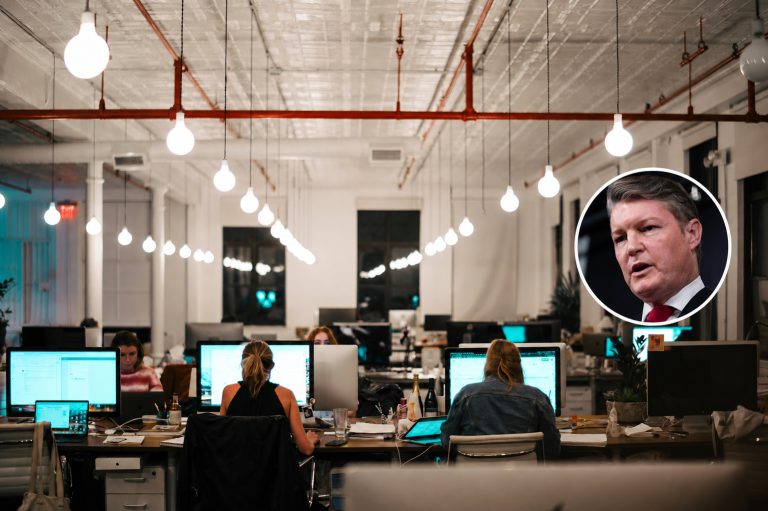
Victorian Premier Ben Carroll’s decision to delay work-from-home laws until July 2027, announced on Tuesday, comes at a time when Melbourne’s much-maligned CBD office story is showing green shoots.
The changes to work-from-home laws were originally slated to take effect from 1 September this year, and adds to amendments made last week to lessen an employer’s onus to foot the bill on work-from-home establishment costs.
This won the support of the Victorian Chamber of Commerce and Industry, which wants the prospective policy scrapped altogether.
“The Premier has been in touch with us directly and has indicated he is willing to meet with us. We hope to persuade him to abandon this destructive course,” Victorian Chamber of Commerce and Industry chief executive Sally Curtain said.
New Victorian Premier Ben Carroll has set his cabinet’s new agenda, set to delay work-from-home laws, and prioritise construction of an airport rail link. Picture: Getty
The state government is also betting on WFH laws taking shape for its own bureaucrats; it’s set to return up to 30,000sqm of office space to the market this year, and 100,000sqm by 2028.
CBRE’s Ashley Buller said while this poses short-term risks to vacancy rates, it means businesses get to right-size their footprint.
“Repositioning well-located buildings/spaces previously occupied by government will result in stronger rental profiles, which longer term will be a benefit to Victorian CBD owners,” the firm’s Joint Head of Office Leasing, Victoria said.
Even before the announced changes from the new premier, CBRE’s view was that the WFH laws’ knock-on effects to office leasing and recovery would be modest.
“We see two potential trends emerging; a shift in occupancy patterns with a greater concentration on mid-week days, and the potential for employers struggling to encourage office attendance using this as a springboard to establish required in-office days,” CBRE’s Office Market Future research paper for July 2026 read.
By and large, tenancy demand has been strong, and absorption has been able to keep up with supply.
Melbourne was the only city to see positive supply and demand rates in the six months to July, according to the Property Council of Australia’s latest office market report.
Supply grew by 0.6%, while demand grew by 0.5%, with the bulk of demand going to A-grade properties – adding to the ‘flight to quality’ phenomenon well-documented so far in 2026.

The ‘flight to quality’ sees most tenant demand concentrated in A-Grade office spaces. Picture: Property Council of Australia
While office yields had softened by 29 basis points over the past year in Melbourne, they sit on the lower end of the spectrum overall, at 5.7% – lower than Brisbane’s and Perth’s, which still breach the 6% threshold. Perth’s, by comparison, rose nearly half a percentage point, up 41bps.
Still, Melbourne has the highest vacancy rates in the nation at 18.9% – but that’s a figure that CBRE’s Tom Broderick expects to see tighten.
“While national CBD vacancy was relatively stable in H1, we expect it to tighten over the next few years given that supply will be significantly below long-term averages,” the firm’s Head of Office & Capital Markets Research, Australia said.
Consequently, prime CBD office space is sitting at a face rent of $773 per square metre – about half the value of Sydney and behind Brisbane’s $894 – according to Knight Frank research, but is growing strongly at 5.2% year-on-year.

Commercial yields data over the three months through June 2026 reveal a mixed picture. Picture: PropTrack / realcommercial.com.au
The changing trends of office precincts
Around 100,000sqm of office space is expected to come online over the next three years, according to the Property Council, which is constrained compared to Sydney, though an increasing number of buildings are expected to be withdrawn or decommissioned as tenants increasingly seek higher-quality stock.
CBRE expects sustained net withdrawals over the next decade to equate to 20% of office stock, most heavily concentrated in the St Kilda Road precinct, where around 128,000sqm of office supply has been withdrawn over the past decade.
This is a structural change to the precinct, currently transforming to become more resident-friendly, which for now experts say isn’t helping the high office vacancy rate.
CBRE research noted that the CBD is undergoing a period of centralisation.

Demand has plummeted in the St Kilda Road precinct, despite a new Metro Tunnel station. Mirvac sold 380 St Kilda Road for $130m just over a month ago. Picture: Supplied
“We’re seeing strong centralisation into Melbourne’s CBD, particularly the Eastern Core and Southern Cross precincts, while many fringe and suburban markets continue to experience negative absorption,” said Cameron Douglas-Perrine, CBRE Research Manager, Victoria.
“Melbourne remains a tenant-favourable market overall, competition is becoming increasingly concentrated in a smaller pool of buildings. The best assets continue to attract strong demand,” said Diarmuid Killeen, CBRE’s Victorian Head of Tenant Representation.
Knight Frank echoed this but also expects the trend to partially unfurl over the coming years as a supply crunch takes hold.
Melbourne’s office recovery phase is complemented by CBD retail’s successes.
The City of Melbourne’s latest Shopfront Vacancy Audit found 85.6% of shopfronts were occupied in April 2026, up from 84.4% a year earlier.
“The number of vacant shopfronts has more than halved since 2021 – showing four straight years of improvement for our local economy,” Lord Mayor Nick Reece said.
The council says around 330 shopfronts are under construction, and the popularity of flagships such as Bourke Street’s Mecca are set to pave the way for other new entrants, such as Muji in 2028.
The latest commercial property news
Get the latest news and insights straight to you.