

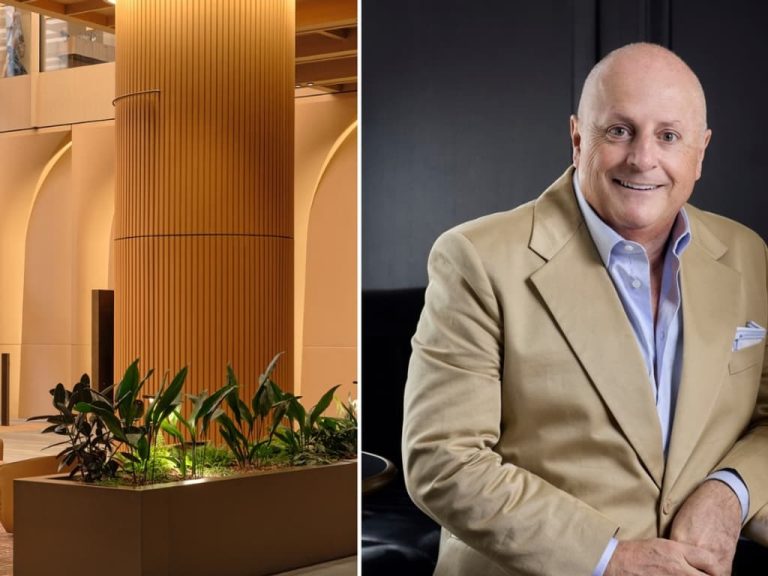
Chris Lucas will shortly open his new Noema restaurant in a Melbourne tower with a solar-skin that will power the airconditioning keeping patrons cool, and much more.
Melbourne office workers are getting hot showers, coffees and even freshly ironed shirts powered by the sun in the city’s first super-sized, solar-skinned tower.
Even diners visiting restaurateur Chris Lucas’ new restaurant Noema in the building will be kept cool with airconditioning partly run by the building’s unprecedented solar farming capacity.
And it’s expected to be a first step towards a new approach to powering the city’s skyscrapers, with early signs it is also helping to get workers back into the office.
RELATED: Scott Pickett’s Smith St Bistrot site in Collingwood on the market
Suburban Melb car parks hiding housing answer
Collins St shop in historic building hits market for $5.5m
The 48-storey. $1.1bn complex at 435 Bourke St has a specialised solar array on three sides of it from level 16 all the way up to a height of 215m above the ground helping building owner, super firm CBUS Property generate 20 per cent of its base energy needs from its walls and roof.
It has the capacity to generate 491kW of solar power from its 2679sq m building-integrated photovoltaic system, equivalent to the solar capturing capacity of more than 74 homes with an average 6.6kw solar array.
The feat of engineering started off as a house-sized test tower outside the CBD as its architects Bates Smart and builders Multiplex tried to work out how to ensure the city-first solar skin could safely delivered.

The photovoltaic panels along the outside of the building blend in with other aspects of the facade’s architecture.
Acting as a prototype to show it can be done, the building’s technology is already being replicated in a Sydney development, and expected to change the way Melbourne’s CBD responds to growing energy demands and bills.
While it won’t have lifts being powered by solar energy, things like the 50 storeys of bathrooms, the massive end of trip facilities including showers and irons, airconditioning and similar are all set to be at least partly powered by the walls around them.
CBUS Property chief executive Chris Kakoufas said other beneficiaries of the solar skin would include revolving doors letting staff into the building, some of the building’s security features, boom gates for the carpark, hand and hair dryers, and even the building’s Wi-Fi.
He added that the technical challenges to the build were likely why they were the first to develop something of this size, but the benefits were clear.

End of trip facilities at the building will be among those to benefit from the solar skin.
“The solar facade has had two functions and creates electricity, but also is acting as a sunshade that stops heat coming into the building and so that also reduces the electrical demand to run cooling,” Mr Kakoufas said.
“Our building delivers up to 20 per cent of the base building power and uses less energy from the grid,” Mr Kakoufas said.
“We are one of the earlier adopters and we have seen that it has an ability to contribute to the value of the building and the tenant’s desires to come into and use the building and ultimately the end value of the building.”
It’s also a win for their more than 900,000 super fund members, who will benefit from a lower energy cost to run the building — and stronger tenancies as corporations look to find similar homes for their offices that can help them meet carbon and sustainability benchmarks for their organisation.

Hot showers will be warmed by heat pump technology that uses electrical energy instead of gas to heat water, and allows the sun shining on the building to contribute.
Its first tenants, the Commonwealth Bank, have already moved in and have reported a surprising outcome — that it’s having an impact on their return to work for staff.
Mr Kakoufas said the result was likely driven by a building design that encouraged social space, such as a sky garden area designed for collaborative work.
Bates Smart architect Cian Davis said with the building having proven the concept, and office buildings’ peak energy demand being during daylight hours, “I think you will see more like it”.
“This would be the most vertical solar panels on one building in the country,” Mr Davis said.
“And there’s more and more manufacturers capable of creating these panels.”
While further buildings being added to Melbourne would be reliant on the office market cycle, future development waves are expected to feature vertical solar arrays with increasing frequency, he said.
“Inevitably the office market will turn and we are pretty optimistic about Victoria, that it will recover and that in new buildings you will see more of it.”

A test facility used to ensure the building could be developed the way CBUS Property intended it to be.
With office tenants increasingly valuing buildings that boost their own green credentials, he added that it was also a way to add a premium to newer towers that had the orientation and location to make it work.
Multiplex’s regional managing director for Victoria Ross Snowball said the installation had been “challenging” with almost 1400 photovoltaic panels integrated into the building envelope.
“(But) it’s a great example of how early collaboration between project partners enables innovation to be embedded into the delivery of a project rather than bolted on at the end,” Mr Snowball said.
While the city does have a handful of other buildings that have advanced solar array set ups, the sheer size of the 435 Bourke St project has made it arguably the first sun tower in the CBD.
It will feature 62,000sq m of office space, hospitality venues, hotel-style amenities for building users and is expected to have supported 3500 jobs during its creation.
Sign up to the Herald Sun Weekly Real Estate Update. Click here to get the latest Victorian property market news delivered direct to your inbox.
MORE: Surging rents surpass affordability protection for half of Melbourne
Inside Wendy’s new Seaford drive-thru