

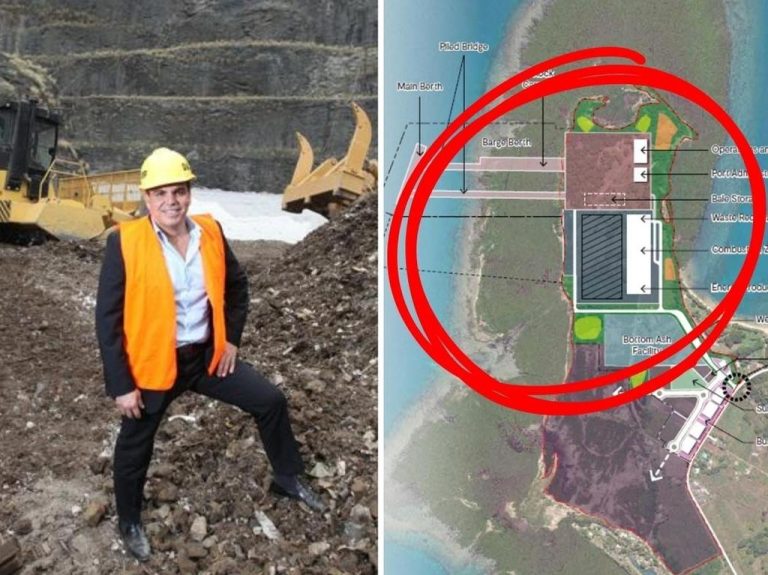
Ian Malouf sold the biggest waste dump in the southern hemisphere at Eastern Creek as part of his Dial-a-dump business for $577.5 million in 2018. Now he wants to get into the industry again with the biggest incinerator in the southern hemisphere.
Australia’s “richest garbo” is pushing ahead with plans for the Southern Hemisphere’s biggest waste incinerator – despite claims it could become “the Pacific’s ashtray”.
The massive $1.4 billion, 900,000-tonne-a-year proposal comes almost eight years after a similar – but smaller – plan was rejected in New South Wales following sustained community opposition and regulatory scrutiny.

Ian Malouf in his $60 million apartment in Sydney. Picture: Ryan Osland

Robert Cromb, managing director of Kookai fashion label, during public consultation on the project. He holds a tourism development lease over the area where the incinerator is being proposed. Source: Facebook/TNGFiji

Protesters have taken holding signs outside an Aussie Kookai retail outlet. Source: Facebook/Protect the Heritage Coast – Vuda, Saweni
The waste-to-energy proposal has now resurfaced, with the Malouf family backing a new development as it moves through a crucial Environmental Impact Assessment (EIA) process in Fiji.
The plant is proposed for Vuda Point, near Nadi – Fiji’s main tourism gateway and a key strip of resorts, beachfront developments and residential land.
Fashion label Kookai managing director Rob Cromb – who grew up in Fiji and is driving the proposal with Mr Malouf’s backing – said the project was “fundamentally different” from earlier Australian proposals.
He pointed to European-standard emissions controls, cyclone-resilient engineering and a design tailored for Fiji conditions.
“It is not a replication of any overseas proposal,” he told News Corp Australia, adding the facility was designed to handle Fiji’s own waste – not Australia’s.
“This project is not about bringing in waste from Australia – it is about dealing with the growing volume of waste already being generated within Fiji,” he said.
However, he acknowledged the plant could eventually rely on imported waste to operate at full capacity.

The energy from waste plant proposal has Kookai managing director Robert Cromb leading the lobbying along with Australia’s richest garbo Ian Malouf. Source: GHD/TNGFiji.

NSW Premier at the time Barry O’Farrell and then Dial A Dump Industries CEO Ian Malouf at the opening of Sydney’s biggest landfill site Genesis, near Eastern Creek in Sydney, which was formerly a hard rock quarry.

Artist’s impression of an incinerator planned for Eastern Creek which was rejected.
Pacific island waste imports have been identified by project proponents as a “supplementary source” to fill future capacity requirements once Fiji’s landfill stockpile is exhausted, with modelling indicating this may occur from around 2033.
The project’s scale is outlined in EIA documentation, which shows the facility is designed to process up to 900,000 tonnes of waste per year – compared with Fiji’s estimated annual waste generation of around 300,000 tonnes.
According to the same modelling, the project would draw on an estimated five million tonnes of existing landfill stockpile, which could contribute approximately 500,000 tonnes per year of feedstock for around a decade.
Project documents also state that “a meaningful share” of long-term operations would rely on waste beyond Fiji’s current disposal stream, depending on how domestic waste volumes and landfill remediation progress over time.
This has contributed to concerns raised by critics about the project’s scale and long-term implications, including warnings from Fiji’s UN ambassador Filipo Tarakinikini that Vuda “must not become the Pacific’s ashtray”.

The final public information session held on Monday night in Fiji. Source: Facebook/TNGFiji

Ian Malouf in a file image on his boat Mischief1 at Jones Bay Wharf in Pyrmont. Picture: Jonathan Ng.
He questioned why a project rejected in Australia should now be pursued in Fiji.
“If this project could not meet Australia’s environmental and health standards … why should Fiji, with far less regulatory infrastructure, accept it?” he said.
Mr Tarakinikini said the scale of the proposal raised concerns that it may be designed to serve a broader regional waste management market, rather than solely Fiji’s domestic needs.
The proposal has ignited a broader debate over Fiji’s future – pitting waste management and energy needs against environmental risks and the country’s global tourism brand, its main source of foreign exchange.
Critics warn a heavy industrial plant in the heart of Fiji’s tourism corridor could hit investor confidence, drag down property values and damage the image that underpins its economy.
Developers argue the opposite, pointing to job creation, energy generation and reduced reliance on imported diesel, but said they were “not in a position” to provide detailed modelling on property market impacts around Vuda and Nadi.
Mr Cromb said the project has not yet been approved.
“At this stage, no final approvals have been granted – the project is subject to the outcome of the Government’s review, including public submissions,” he said.
April 22 is the final day Fiji’s environment department will accept public submissions on the proposal, with the final decision resting with the Rabuka Government.