

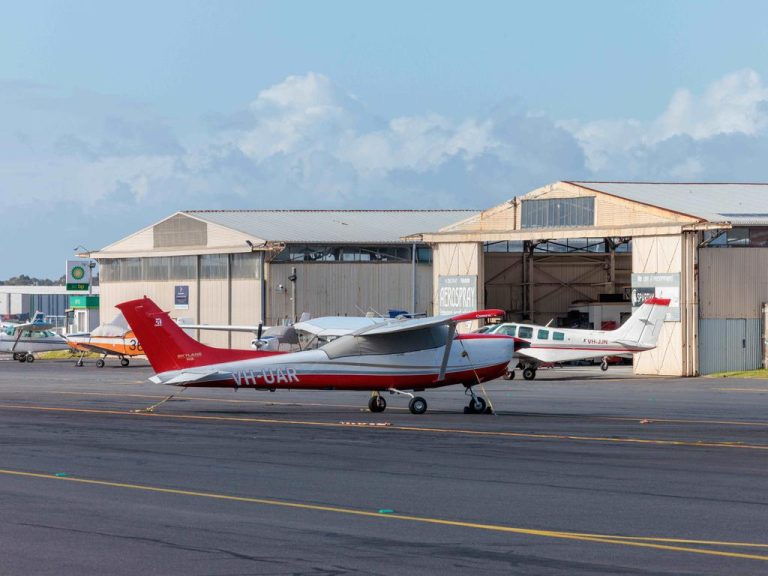
A consortium led by Barings is looking to buy Moorabbin Airport from the Goodman Group.
The Australian arm of international funds manager Barings and a consortium of four major investment funds are in talks to buy Melbourne’s Moorabbin Airport from industrial property company the Goodman Group and its funds for more than $1.5bn.
The transaction has been quietly negotiated by Barings and Goodman with the superannuation funds, including Aware Super and Rest Super, alongside two undisclosed funds, brought in amid strong demand for airports among institutional investors.
Big investors are looking to lift their exposure to airports, despite global volatility, due to their attractive investment profile and the ability to add value by developing the surrounding properties.
The deal, which is pending approvals, would also be a coup for Barings, which has been stepping up its presence in Australian property and has about $9bn worth of local assets, including experience in airports.
Big investors like airports partly for their terminals and runways but also their valuable lands, that can be converted into industrial parks, shopping centres, offices and even hotels. Barings, which sports a near $700bn global investment network, is looking to pick up the airport at a time when Goodman is selling assets. It is selling partly in order to fund the rollout of its new data centres around the world, although the bulk of the Moorabbin precinct is held in its flagship unlisted fund.
Local firm Altis teamed up with Aware, when it was known as First State Super, to buy Bankstown and Camden airports in Sydney for $203m in 2015. Barings acquired Altis in 2022.
The airports in the city’s southwest are now run under the Aeria Management Group banner and it has pushed into logistics developments. The 310ha Bankstown Airport houses the Altitude Industrial Estate but the Sydney airports and facilities are not connected to the play for the airport in Melbourne.
Moorabbin Airport in southeast Melbourne is already the country’s top general aviation flight training airport and offers room for expansion. The site spans 294 hectares and the airport is the country’s second busiest air base, housing flight training, charters, aviation maintenance and aviation, which will continue normal operations.
The big commercial drawcard is Goodman’s expansion of non-aviation commercial activities. These include the Kingston Central Plaza and a busy Direct Factory Outlet. Chifley Business Park, on the airport perimeter, also houses industrial facilities and offices. Moorabbin Airport has also been expanding its business precinct, with two recent developments.
Goodman launched a pilot project to enter mass timber construction as it looks to slash carbon emissions in its developments. It also developed an automated distribution facility for electrical wholesaler Lawrence and Hanson.
Industrial property making up about two-thirds of the site by value is owned by an unlisted Goodman fund, while the company owns the aviation and ground leases, including some retailing.
Goodman Group bought Moorabbin Airport from a company linked to its now billionaire chief executive, Greg Goodman, in 2010. The Goodman family’s Goodman Holdings and Beeside sold the property for $201.5m to the listed property trust.
It bought the airport using a mix of $146.5m in shares, cash and vendor finance in a deal backed by investors and an independent expert. It then developed out the area around the airport for its main industrial fund.
The airport deal effectively brought Mr Goodman and his family back into the listed company with a stake of about 3.4 per cent after the Global Financial Crisis had hit the value of his holdings. The country’s secondary airports are highly active for smaller aircraft but the real economic attraction is the ability of owners to develop warehousing, offices and shopping outlets in surrounding areas.
The parties declined to comment with the transaction expected to require multiple approvals.
Airports have been in focus, partly as a result of the Middle East crisis that could impact their operations. However, super funds look past temporary volatility and target longer-term assets they believe can generate above inflation returns.
Airports have also been the site of a clash between superannuation funds, with rival groups lining up for and against Dexus in a scrap over the ownership of Melbourne and Launceston airports.
That dispute is set to go to court next month and shows the keen contest by large investors to secure the infrastructure assets, with IFM Investors driving the Melbourne airport battle against Dexus.
Airports are some of the last major land parcels in major capitals where owners have the chance to add value by expanding both aeronautic operations and undertaking real estate projects, especially since land remains costly.