

Australia’s data centre boom is generating more competition for industrial land, with developers competing for sites that offer the scale, power, and connectivity needed to support AI.
Surging data centre demand is already influencing land values, but a growing pipeline of speculative projects raises a question for industrial property investors: what happens if the demand underpinning these premiums fails to materialise.
Research conducted by JLL shows data centre developers have been paying land premiums between 20 to 182 percent above traditional industrial values, with higher premiums seen for the larger sites needed to house AI data centres.
In Sydney’s Outer Central West, for example, 2-5 hectare lots have seen growth of 9.6% compared to 2.5% for 1 hectare lots over the past 12 months, according to JLL. In Melbourne’s West, 2-5 hectare lots grew by 16.5% versus 4.4% for 1 hectare lots.
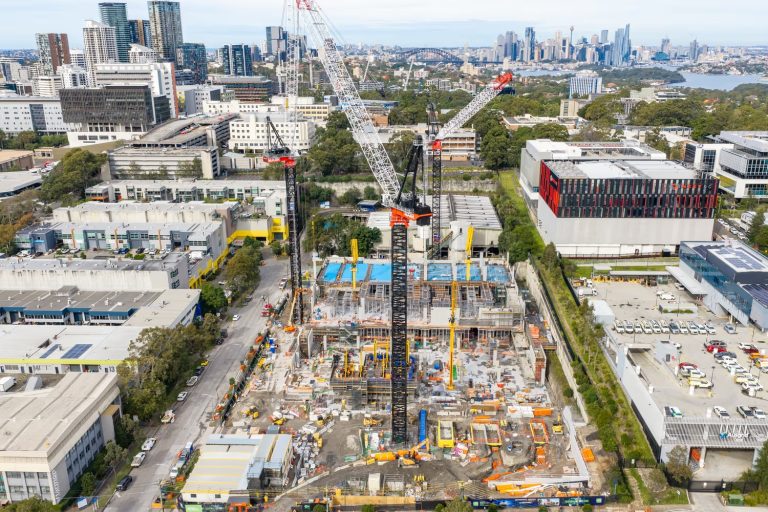
Data centres, like this one in Melbourne, are springing up across Australia.
The scale of Australia’s proposed data centre pipeline is striking. Data Centres Australia’s April 2026 Forecast Report identified 21.6 gigawatts (GW) of capacity at various stages in the pipeline. Of this, 78% was classified as early stage capacity, with just 0.2GW of this actually under construction.
This distinction matters for industrial property. Early stage projects are not equivalent to funded developments ready to proceed. Many still need to secure electricity connections, planning approvals, financing, and committed customers. On top of this, hyperscale data centres are having to deal with growing community pushback.
For landowners, this creates a risk that values are being influenced by development potential rather than a project’s likelihood of proceeding. A site purchased at a substantial premium may be worth considerably less if its proposed data centre can’t be delivered.
Goodman Group’s decision to abandon its proposed A$1.2 billion, 90-megawatt Project Mars data centre at Lane Cove illustrates this risk. The project was withdrawn following community opposition and changing regulatory conditions, demonstrating that land and capital alone do not guarantee development.
Bain & Company’s 2026 Global Technology Report highlights the scale of the challenge facing the AI industry. They estimate that AI will need to generate US$6 trillion in annual revenue by 2031 to support the projected infrastructure investment behind the AI boom.
According to Bain & Company, existing consumer and enterprise applications could contribute US$1.2 to US$1.8 trillion, leaving a substantial gap to be filled by new products and markets.
The Reserve Bank of Australia has raised a related concern, with governor Michele Bullock warning that an unwinding of the AI boom could affect financial stability and the broader economy.

The data centre in Bundey, SA will take advantage of ample renewable energy supplied by the Bundey Substation. Picture: Consolidated Power Projects
Firmus’ withdrawal of its IPO in October provides another reminder that access to capital cannot be taken for granted. While it doesn’t prove that demand for data centres is collapsing, it illustrates the growing scrutiny facing businesses seeking funding in the AI space.
For owners of multi-hectare industrial land, data centres offer the prospect of substantial land premiums, especially where sites have good access to power infrastructure and planning suitability.
However, these premiums also have implications for the industrial sector more broadly. With more data centre developers competing for these sites, conventional industrial developers may face higher acquisition costs, making new warehouse projects harder to justify.
If industrial developers are priced out of sites because development costs are too high relative to achievable rents, future traditional industrial warehouse supply could be constrained.
However, the reverse is also possible. If speculative data centre projects fail to proceed, land may return to the conventional industrial market, easing competition for sites and reducing the premium associated with large land parcels.
A slowdown in AI spending would not eliminate demand for data centres. Cloud computing, data storage and digital services have established uses, and well capitalised operators with committed customers should remain resilient.
If hyperscalers and AI companies slow expansion or cancel commitments, some data centre projects are likely to be abandoned. Development sites bought at a premium could see values fall, while developers, contractors, and lenders could face significant losses.
The latest commercial property news
Get the latest news and insights straight to you.