

Australia has a forgotten “capital” – and today it’s a ghost town of crumbling buildings, cattle dust and a pub where no one’s poured a beer in decades.
Long before Darwin cemented its place as the Northern Territory’s powerhouse, Newcastle Waters was officially chosen to become the seat of government for North Australia, in one of the nation’s strangest political what-ifs.
In 1926, under the northern Australia Act, the Commonwealth split the Northern Territory into two jurisdictions – North Australia and Central Australia.
Alice Springs was to serve as the capital of Central Australia, while Newcastle Waters – approximately 710km south of Darwin – was selected to become the seat of government for the north.
MORE NEWS
The Aus city that cost millions – then vanished
Wild reason Aussies mobbed rural ghost town
Shocking photos expose outback apocalypse
The law left little room for doubt.
“The seat of government of North Australia shall be established as soon as practical at Newcastle Waters, and until the seat of Government is so established it shall be at Darwin,” Section 47 of The northern Australia Act declared on June 4.
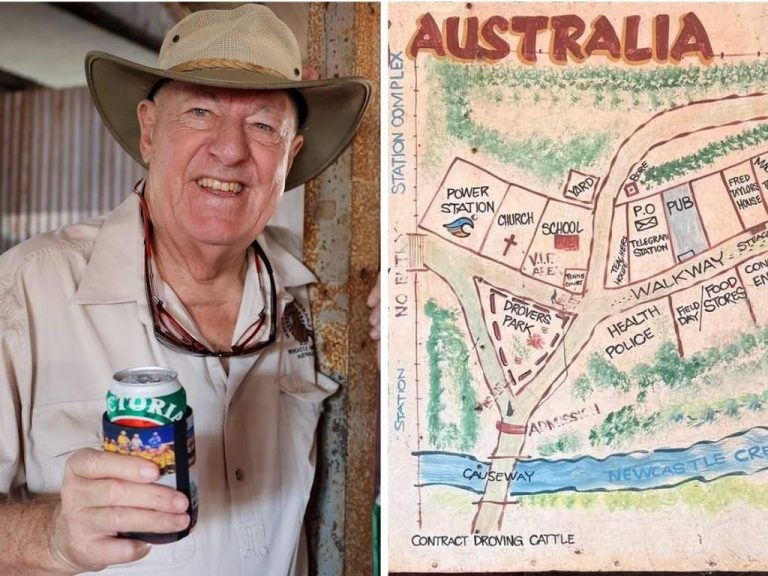
A map of the township. Source: Facebook

Wayne Kraft (left) and the Mates of the Murranji try to keep the township alive. Source: Facebook
For Wayne Kraft, an amateur historian from Alice Springs, that extraordinary slice of Territory history still feels alive the moment he steps inside the old Junction Hotel.
“I’ve walked in here on my own and I can hear the walls talk,” he told the ABC.
Walking through the abandoned pub, he imagines the patrons, workers and drovers who once gave the place its energy.
“It’s the pub with no beer,” he said.
“It just reeks of that history.”
MORE NEWS: ‘Real mess’: 101yo grandma trapped in fence feud

The old General Store. Picture: Supplied

The old Jones Store. Picture: Facebook
That history runs deeper than many Australians would realise.
Long before it fell silent, Newcastle Waters was a key inland hub, built on the edge of the vast cattle station of the same name.
Nearby ran the Overland Telegraph Line, while stock routes from across the north converged on the settlement.
At a time when Darwin was largely accessed by sea and overland connections were poor, Newcastle Waters made a certain practical sense.
Over time it developed the institutions of a serious frontier town: The Junction Hotel, a general store, police station, church, post office and an airport serviced by Qantas.
One of its most important businesses was Jones Store, which opened around 1934.
More than a shop, it operated as a butchery, bakery and poultry business, helping sustain life in the remote township.

The Newcastle Waters Police Station. The policemen stationed there had plenty to do when drovers came to town after their long trips to deliver cattle in Queensland

Max Schober (at right) with aviators who had landed to refuel at Newcastle Waters.
Now owned by the National Trust, it has been carefully restored by volunteers and remains one of the clearest reminders of Newcastle Waters’ busier past.
At its peak, the settlement was also a vital stop for drovers moving thousands of cattle from as far away as the Kimberley on punishing journeys towards Queensland.
But for all its promise, Newcastle Waters’ flirtation with political greatness was short-lived.
The split between North Australia and Central Australia lasted only five years.
By 1931, both had been abolished, the Northern Territory was re-established and Darwin retained its position as the administrative centre.
Mr Kraft believes the explanation was simple.
“Probably no money; decisions made in Canberra often don’t resonate here in the Territory even to this day,” he said.
“That actual act of Parliament was rescinded five years later.
“Darwin always retained its position as the capital of the NT.”

Max Schober, bush entrepreneur at Newcastle Waters. He owned the hotel and ran a store in the township, located near the later settlement of Elliott

Even after its capital city dream faded, Newcastle Waters continued to thrive for a time. Through the war years and into the mid-20th century, the cattle industry kept the township going.
But the same changes that modernised the north eventually destroy the economic foundations it relied on.
In the 1960s, road trains increasingly replaced droving as the preferred way to move cattle. The opening of abattoirs in Darwin in 1963 and Katherine in 1964 accelerated the shift. Government records show 24,550 head travelled along the Murranji in 1962.
That dropped to 14,350 in 1963, and by 1967 – the final year of droving on the route – only 2,653 cattle made the trip.
As the bores fell into disuse and scrub reclaimed the track, Newcastle Waters entered terminal decline.

Inside The Junction Hotel at Newcastle Waters Township. Picture: Floss Adams.

Junction Hotel at Newcastle Waters Township has been closed since 1976 but still stands. Picture: Floss Adams.
The Junction Hotel closed in the mid-1960s, with its liquor licence transferred to the Elliott Hotel.
Jones Store survived longer but eventually shut in 1985.
As for the township, it was formally heritage listed on November 11, 1993.
Today, the old township has no permanent residents, but it has not disappeared entirely.
The Newcastle Waters School still operates nearby, serving children from Aboriginal communities in the region, while the station homestead remains active just beyond the historic precinct.
For Mr Kraft and his group, Mates of the Murranji, preserving the township is about more than keeping old buildings standing.
It is about protecting one of the Territory’s most surprising stories – and reminding Australians just how differently the map of power could have looked.