

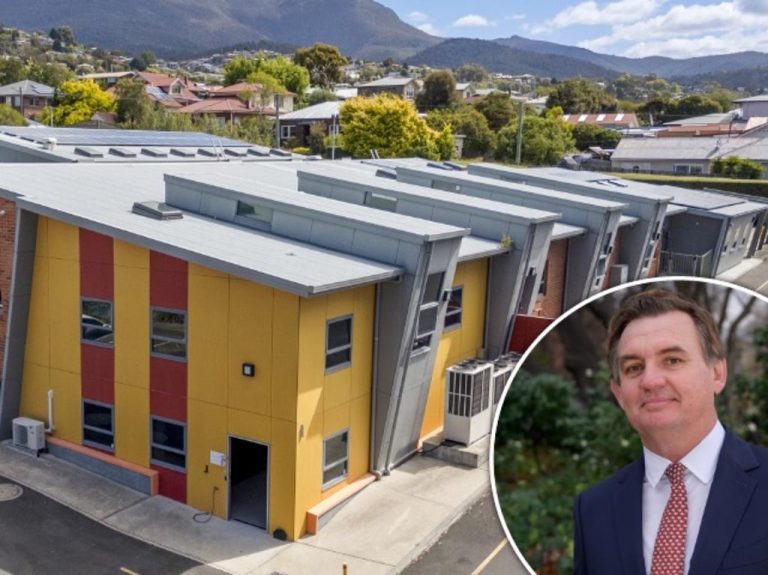
SOLD: A healthcare asset at No.11a Gant St, Lenah Valley. Inset, Scott Newton from Elders Tasmania. Picture: Supplied
OPINION
Halfway through 2026, Tasmania’s commercial property market is telling a clear story: more deals are getting done, prices are holding steady on the year, and the centre of activity remains firmly in the South.
After a solid 2025, the first six months of 2026 have brought a genuine lift in transaction activity across the state’s industrial, retail, office and hospitality sectors, and viewed against the last decade, it’s the continuation of a longer run of growth rather than a one-off spike.
Elders Commercial’s ongoing tracking of the Tasmanian commercial market recorded 141 sales during the first half of 2026, up 33 per cent on the 106 transactions logged over the same period in 2025. All reflecting a level of sustained deal flow rarely seen in a market of Tasmania’s size.
Importantly, this increase in volume hasn’t come at the cost of price discipline.
The median disclosed sale price sat at $1.6m in H1 2026, barely different from $1.59m over the same months last year.
That stability across a much busier market suggests confidence is broadbased rather than concentrated in a handful of large deals.
Zoom out, though, and the longer-run picture shows just how far the market has travelled to get here; more on that below.
MORE: It’s a spectacular ruin, and it could be yours
Blank slate by the beach: Howrah Point land sale
Sold: The Moorings drops anchor in multimillion-dollar deal
Historic home stops strangers in their tracks

Elders Tasmania Commercial state manager Scott Newton. Picture: Supplied
RETAIL OVERTAKES INDUSTRIAL
The sector mix has also shifted. Industrial property, long the engine room of Tasmania’s ‘post-Covid’ commercial market, has been overtaken by retail as the most active category by volume: 44 retail sales in H1 2026 compared with 36 industrial, a reversal of the pattern seen in 2025.
Median prices eased across industrial, retail and office property, though this reflects a shift toward smaller, more affordable stock changing hands rather than a fall in like-for-like asset values.
Large set-piece sales, like 2025’s $50.25m Glebe Hill Village transaction in Howrah, were the exception rather than the rule in the 2026 data.
MORE: Neat package: Eco-builder lists eight-star home
From billionaire’s retreat to your blank canvas
Hand-built Honeywood home three decades in the making

Glebe Hill Village. Picture: Supplied
Our longer-run market data backs this up as a multi-year trend rather than a single-half blip.
Industrial’s share of tracked commercial transactions has held remarkably steady at around a third of the market since 2018 (31.6 per cent then, 31.2 per cent in H1 2026), while retail’s share has climbed from 26 per cent to 35 per cent over the same stretch.
Office and hospitality have both eased back over the same period.
Retail’s rise has been building for years; 2026 is simply the year it caught up.
The standout transaction of H1 2026 was the sale of No.170-178 Elizabeth St in Launceston, an industrial property sold by Elders Commercial in February.
It’s a reminder that while retail is leading on volume, industrial assets remain some of the highest-value deals in the market.

No.170-178 Elizabeth St, Launceston.
THE SOUTH’S LEAD DEEPENS
Geographically, the South accounted for 51 per cent of all sales in H1 2026, up from 38 per cent over the same period last year, while the North’s share slipped from 40 per cent to 35 per cent.
Read against a single year-on-year comparison, that looks like a sudden swing — but our decade-long market data tells a steadier story: the South has been Tasmania’s largest commercial region every year since at least 2018, consistently taking 42-49 per cent of tracked transactions.
H1 2026’s reading is best understood as a decade high for an already well-established lead, not a new phenomenon.

No.110-114 Gilbert St, Latrobe.
A DECADE OF TAS COMMERCIAL PROPERTY
Data from Elders Commercial Market IQ from the previous decade shows a market that has re-rated significantly, with the median price for a Tasmanian commercial sale in the first half of the year growing from $407,000 in H1 2015 to $1.6m in H1 2026 — an increase of roughly 293 per cent, or a compound growth rate of about 13 per cent per year.
That growth wasn’t a straight line.

No.115 Wellington St, Launceston.
Prices moved in a relatively tight band through the second half of the 2010s, generally between $400,000 and $600,000, before a clear inflection point from 2021 onward as the market re-rated sharply: H1 medians roughly tripled from $605,000 in 2021 to $1.6m in 2026.
The past five years, in other words, have done most of the work in this decade’s growth story.
INVESTORS STEP BACK IN
Buyer behaviour has shifted too. Among H1 transactions where buyer type was disclosed, investors accounted for 55 per cent of purchases in 2026, up from 39 per cent in 2025, while owner-occupier activity held steady near 29 per cent and developer purchases eased from 23 per cent to 17 per cent.
That renewed investor appetite, without a corresponding jump in price over the year, points to buyers backing Tasmania’s fundamentals rather than chasing capital growth.

No.112 William St, Devonport.
Interstate and overseas buyers made up a smaller share of the market than last year, 35 per cent of disclosed purchases, down from 42 per cent, but where they did buy, they concentrated heavily in retail: 77 per cent of interstate purchases in H1 2026 were retail assets, a much narrower focus than the spread across retail, hotels, offices and development sites seen in 2025.
Interstate buyers also continued to pay a premium over local buyers in both years, consistent with their tendency to target larger, tenanted assets.

No.184 High St, Campbell Town.
LOOKING AHEAD
Taken together, the data points to a Tasmanian commercial market that is growing in depth, not just in a single busy half, but over a decade of steadily rising.
Layer fresh volume growth and renewed investor appetite on top of that foundation, and 2026 is shaping up to be one of the more active years for Tasmanian commercial property in over a decade of records.
Scott Newton is Elders Tasmania’s head of real estate