

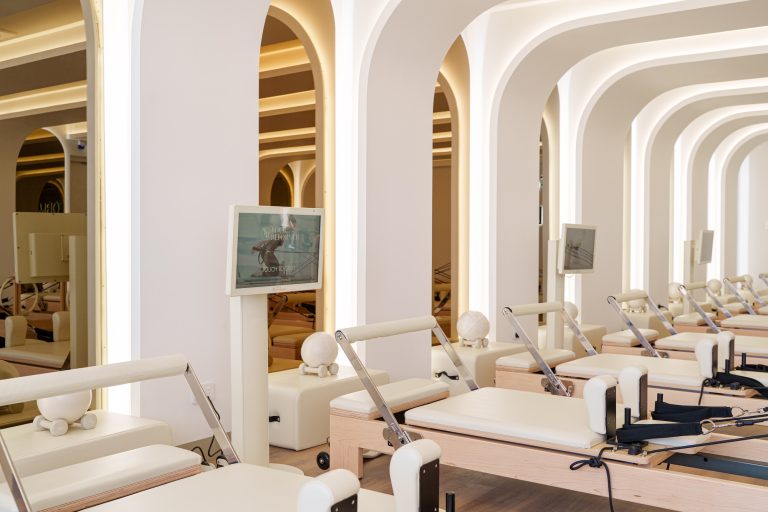
Premium gyms offering everything from personalised training to luxury wellness facilities are finding room to grow in Australia’s increasingly crowded $3.7 billion fitness industry.
With traditional operators facing rising costs and shrinking profit margins, demand for more specialised fitness experiences is creating opportunities for businesses catering to different demographics and budgets.
According to new IBISWorld research, Australia’s gym and fitness centre industry is expected to generate $3.7 billion in revenue in 2025-26, down 1.8% on the previous year.
Despite the downturn, the number of gym businesses is forecast to grow by 4.9% annually over the next five years, compared with projected annual revenue growth of just 1.1%.
Fitness Cartel is taking the traditional gym format and taking it upmarket. Picture: Supplied
The figures point to an increasingly competitive market, with more operators vying for a share of relatively modest revenue growth while contending with rising rents and operating costs.
However, IBISWorld identifies premium gyms as an area of future growth, with operators offering everything from exclusive personal training to expansive health clubs incorporating Pilates and wellness facilities.
Some target affluent clients prepared to spend hundreds of dollars a week, while others are offering high-end experiences at prices comparable to conventional gyms.
The price of exclusivity
After witnessing the boutique fitness market become increasingly saturated, Lachlan Rowston and his business partner sold their three CrossFit gyms to launch Lockeroom – an exclusive personal training business targeting CEOs, founders and entrepreneurs.
Lockeroom offers personalised coaching in a private setting, with flexible bookings and a two-to-one training model. But exclusivity comes at a price, with members typically spending $300 to $400 a week.

Lockeroom co-founder Lachlan Rowston started the business after identifying a need to deliver fitness results to Australia’s corporate executives. Picture: Supplied
Mr Rowston told Real Commercial the concept was designed to address common frustrations with conventional gyms, like crowded facilities and inflexible training schedules.
“The downside of a commercial gym is you have to share it with everyone else. They’re busy, loud and dirty – all the things that our type of clientele, even if they have the money, can’t pay to get rid of because that’s just part of the model,” he said.
“Busy executives and founders’ schedules constantly change, so our two-to-one training model allows clients to book more flexibly and get better results.”
The concept also provides opportunities to connect with like-minded professionals, although Mr Rowston insists Lockeroom is a gym first and business networking social club second.
“Our clients’ main goal is to get fit and strong. Networking is secondary and happens organically alongside the workouts – it never feels forced. We believe shared intent, rather than a shared agenda, is the best way to do business.”

Mr Rowston founded Lockeroom with business partner Raphael Freedman. Picture: Supplied
The commercial property strategy is equally targeted, with Lockeroom’s Melbourne and Sydney CBD locations deliberately positioned near major office buildings to attract corporate clientele.
“We’re choosing close to the most expensive real estate in the country, but a commercial setting can secure far more clients than residential. An office tower that holds 7,000 people is churning constantly – every year you’ve got a new crop of people you can sell to,” Mr Rowston said.
“It puts a lot of pressure on the business to secure memberships quickly because the bills are big and they come fast, but it’s equally a huge barrier to entry for competitors. They run the numbers and quickly realise they don’t have the kahunas to sign those sorts of leases. But that’s our style – we like to take risks and back ourselves. It’s worked out so far.”
Looking ahead, Mr Rowston predicts Australia’s fitness market will become increasingly divided between budget chains and exclusive premium operators, leaving mid-market boutique gyms struggling to survive.
“The numbers just don’t work anymore. The rents and cost to build are too high.”
Luxury fitness on a grand scale
It’s a sentiment echoed by Fitness Cartel co-founder and CEO Nathan James, who believes operators must evolve to meet changing consumer expectations.
“Many of our competitors, who had the monopoly early on, have failed to adapt their offering to meet the modern customer’s needs, and have fallen behind as a result,” Mr James said.
While Australia’s broader fitness industry faces mounting financial pressures, Queensland-based Fitness Cartel reported 45% revenue growth in 2025–26, driven by an ambitious expansion into large-format gyms offering premium wellness and recovery facilities.
Founded in 2020, the company has grown to 18 locations and more than 60,000 members, with basic memberships costing around $20 to $25 a week – a fraction of the price charged by exclusive personal training concepts.

Pressure creates new business successes, too. Picture: Supplied
IBISWorld identifies growing demand for integrated fitness and wellness experiences, with consumers increasingly seeking facilities combining exercise, recovery and lifestyle amenities under one roof.
“Beyond a gym, our members expect an integrated experience in a luxury setting and that’s exactly what we are delivering with our new club format – combining the traditional gym offering with a premium wellness and recovery space and six-star amenities,” Mr James said.
Recent openings include a $7 million, 3,500sqm superclub in Toowoomba, a growth hotspot of southeast Queensland, with the company planning to expand its network to 60 clubs by 2030.
Large-format retail centres, mixed-use developments and regional shopping precincts are among its preferred locations, with Fitness Cartel seeking sites of at least 2,000sqm and parking for 150 cars.
Priority expansion markets include the northern and central Gold Coast, Brisbane’s bayside suburbs and south-west Sydney.

Merse is focusing on the wellness end of the market. Picture: Supplied
Fitness Cartel Head of Property Kyle Swain said the company was targeting metropolitan and larger regional markets over the next three years, while seeking partnerships with developers and landlords.
The company is also expanding beyond traditional gyms, recently unveiling a $3 million Merse Wellness Spa in Coomera to capitalise on growing demand for recovery and wellness facilities.
“Coomera is absolutely thriving and we saw a real opportunity to create something dedicated purely to wellness, recovery and relaxation at this level,” Mr James said.
“We’re creating a hub where people can prioritise their health, recovery and wellbeing as part of everyday life, not just as an occasional luxury.”
.rca-cta-container {
border: 1px solid #ddd;
display: flex;
align-items: center;
gap: 20px;
padding: 30px;
border-radius: 8px;
margin: 40px 0;
flex-wrap: wrap;
}
The latest commercial property news
Get the latest news and insights straight to you.
Sign up
The post The premium divide: How luxury gyms are flexing in a crowded market appeared first on realcommercial.com.au.